EHR Overview
|
The Electronic Health Record (EHR) module is a core axiUm module that allows you to view and manage all clinical parts of a patient’s record. It enables you to chart dental conditions and procedures; create treatment plans; review treatment history; add and complete patient forms; create attachments and consents; and manage imaging, medications, and medical tests. The EHR works in conjunction with other modules, including Attachments/Consents, Perio Chart, Lab Tracking, Forms, and Treatment Planning. It can also work with several integrations, including Digital Imaging, eRx, and DDX eLab.  Access Access
You can open the EHR module using one of the following methods:
Tip: You can also click the arrow ( Organization
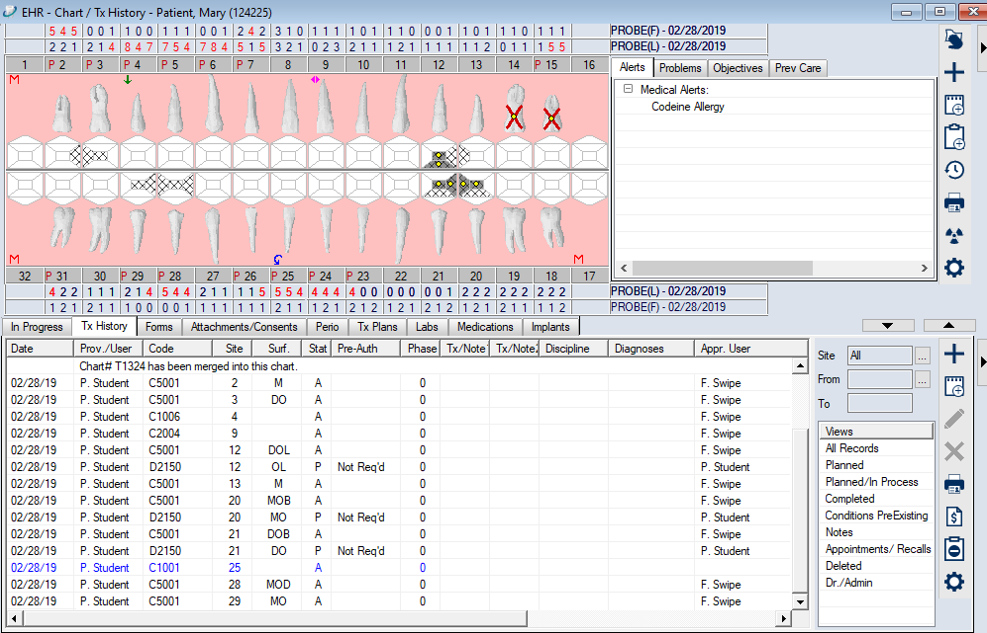
Important: The EHR module is highly customizable and its layout varies greatly based on your institution’s configuration. The EHR module is generally separated into an upper pane and a lower pane. The upper pane usually displays the odontogram and a small set of sub-tabs. The lower pane offers several tabs that allow you to view additional information and perform tasks. Tip: Some tabs are unique to the EHR module (e.g., Tx History and Tx Plans), while others offer quick access to information from other modules (e.g., Perio). The EHR also typically displays two toolbars. One displays next to the Odontogram and applies to the Chart Add tab. The second tool bar displays next to the open tab in the lower pane.
The toolbars offer several icons depending on the open tab:
Customize the View
If necessary, you can maximize the EHR window to display only one tab. Additionally, you can move tabs between the upper and lower panes. To customize the view:
Reports
You can run a variety of custom reports from the Info Manager module > Clinical tab that pull information from the EHR module. You can use these reports the same as other Info Manager reports. You can customize, create, filter, save, and print or export them. Key reports include the following:
|
 ) icon.
 ) icon to display the list of EHR sub-tabs and select one to open the EHR module to that tab.
 ): Allows you to display the Chart Add tab and
  ): Allows you to display the Select Note Type window and
  ): Allows you to edit the selected record.
 ): Allows you to delete a selected record.
 ): Allows you to
  ): Allows you to view the history of a selected record.
 ): Allows you to print the selected entry.
 ): Allows you to display the Add Patient Consent window and
  ): Allows you to display the Patient Exposures window.
 ): Allows you to display the EHR Options window and
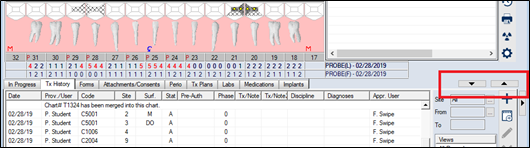
  ) to maximize the lower pane.
 ) to maximize the upper pane.